So You Think You Need a Combustion Analyzer
All You Ever Wanted to Know About Combustion Analyzers... And More!
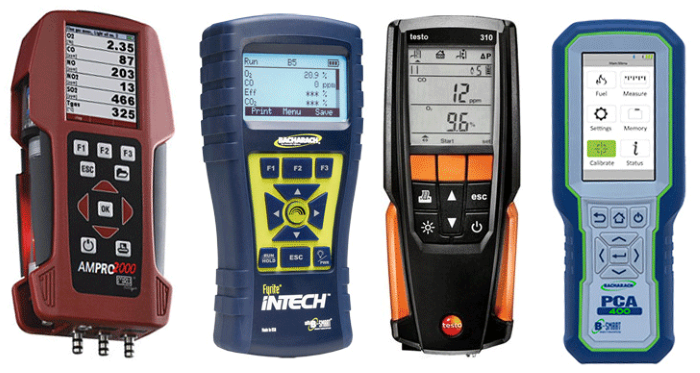 Combustion analyzers are multi-function instruments designed to calculate the efficiency of all types of boilers, heaters and furnaces by measuring a range of parameters such as stack
temperature, flue pressure and levels of gases. Through the analysis of these parameters, it's possible to improve combustion efficiency resulting in lower fuel costs, fewer pollutants
being emitted, and lower expenses.
Combustion analyzers are multi-function instruments designed to calculate the efficiency of all types of boilers, heaters and furnaces by measuring a range of parameters such as stack
temperature, flue pressure and levels of gases. Through the analysis of these parameters, it's possible to improve combustion efficiency resulting in lower fuel costs, fewer pollutants
being emitted, and lower expenses.
Combustion occurs when fuel, generally a fossil fuel, reacts with oxygen to produce heat. When combustion is harnessed to provide usable heat, the objective is to burn the fuel as completely as possible with the least amount of loss. Combustion analyzers can find the ideal fuel to air ratio for each application so as to come as close as possible to complete combustion.
Who Needs a Combustion Analyzer?
Combustion analyzers are ideal for setting up and commissioning complex multi-stage, or modulating heating systems as well as basic testing and tuning of all types of boilers, heater or furnaces. Though anyone with a heater, boiler, kiln or furnace can benefit from them, combustion analyzers are most useful for HVAC professionals or technicians in larger facilities subject to high fuel costs and EPA regulations which set specific standards for certain emissions that are harmful to the environment.
How Do Combustion Analyzers Work?
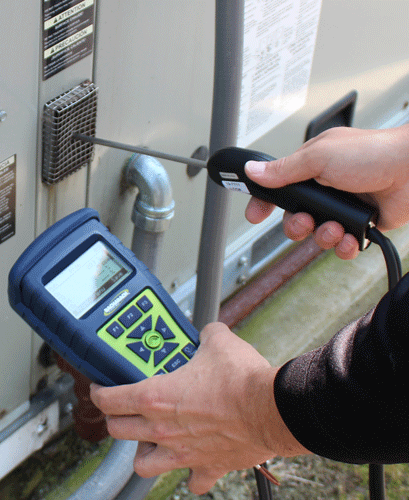 Since improving combustion can be simplified to burning fuel completely and minimizing harmful emissions, combustion analyzers use an array of sensors, usually packaged in a portable instrument for
use in the field, that quickly and accurately provide the information required to improve combustion. An attached probe permits easy insertion into the exhaust where measurements are made.
Since improving combustion can be simplified to burning fuel completely and minimizing harmful emissions, combustion analyzers use an array of sensors, usually packaged in a portable instrument for
use in the field, that quickly and accurately provide the information required to improve combustion. An attached probe permits easy insertion into the exhaust where measurements are made.
Though there is some difference between models as to which sensors are included, most combustion analyzers include a thermocouple, pressure sensors, O2 sensor, and CO sensor. In addition, since different fuels have different characteristics when analyzed, most models include pre-set fuel profiles.
The sensors included in combustion analyzers provide a number of direct measurements as well as the ability to calculate other rates.
What, Exactly, Do Combustion Analyzers Measure?
Oxygen (O2): When oxygen appears in flue gas it's a sign more air was supplied than necessary for combustion.
Carbon monoxide (CO): Carbon monoxide in the exhaust gas is a sign of incomplete combustion due to inadequate air supply. Ample oxygen will combine with CO to produce CO2.
Inlet Temperature: Inlet temperatures indicate the amount of heat entering the system by supply air. When determining heat loss, inlet temperatures are compared to flue temperatures providing net heating information.
Flue Temperature: High flue temperatures reveal heat loss. While some heat loss is unavoidable, the lost heat is a major cause of lower fuel efficiency.
Draft: Draft is the rate at which exhaust gas is vented away as measured by pressure sensors. Excessive draft can prevent heat transfer to the system while inadequate draft allows water vapor and harmful gases to accumulate.
Efficiency: Combustion efficiency is a calculated measurement of how effectively fuel is converted into heat.
Carbon dioxide (CO2: Carbon dioxide values are calculated from O2and CO measurements. CO2 along with water vapor, should be the only gases present if combustion is stoichiometric.
Excess Air: A calculated value of the amount of air above what is required for complete combustion. Too much excess air can absorb heat resulting in lower system efficiency.
In addition to the sensors included within the instrument, combustion analyzers often include a number of additional features designed to improve the user experience or to increase the versatility of the instrument. Some types of additional features include printers, data loggers, communications, toxic gas sensors, and others.
How Do I Decide Which Combustion Analyzer Is For Me?
- Which parameters do you need to measure?
- Which fuel is being used?
- Do you need communications to send information to a computer or other device?
- Do you need to print or data log the measurements?
- Which accessories (probes, hoses, sensors, software, etc.) do you need?
If you need help selecting the combustion analyzer that's right for you, please don't hesitate to speak with one of our engineers by e-mailing us at sales@instrumart.com or calling 1-800-884-4967.
Questions?
Feel free to give us a call at 1-800-884-4967